
Spryng V5: understand what people are actually living through
Introducing Spryng V5: story-based research, shared interpretation and practical follow-through. Join our book-launch webinar on November 17.
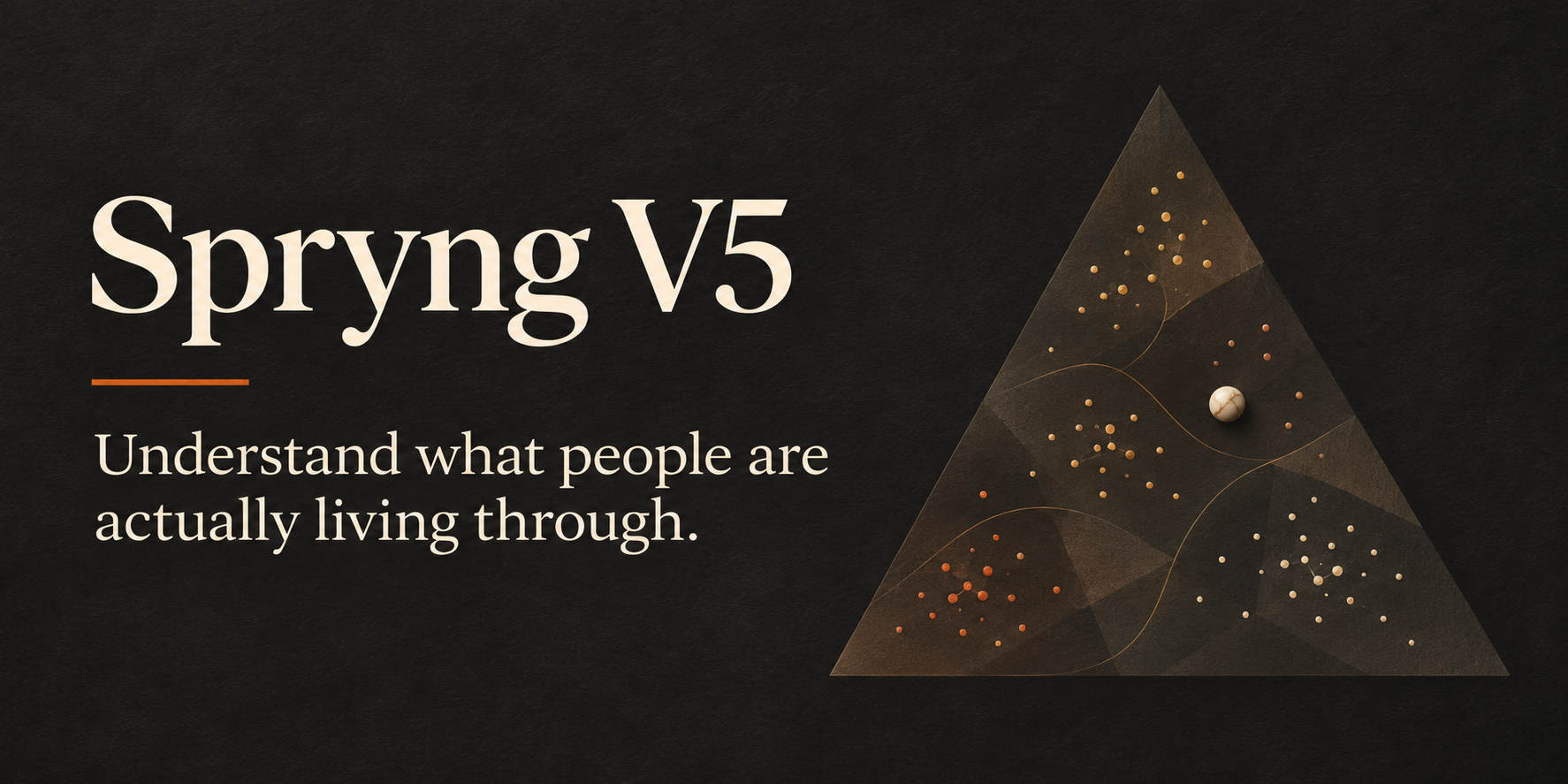
A leader's idea of alignment can feel like surveillance to someone on the front line. A change described as efficient can leave a customer or citizen feeling confused or disregarded. Everyone has the same facts, and they are living through very different situations.
That gap between what we think is happening and what people are actually experiencing is what Spryng exists to close. Today we are introducing Spryng V5, the fifth generation of the Spryng app, alongside our new book, Designing Sensemaking Studies, available on Amazon from November 3.
Join us live: CarrieLynn D. Reinhard and I are hosting a book-launch webinar on Tuesday, November 17, 12:00–12:45 PM Eastern. We'll walk through a real study design end to end and take your questions. Save your seat
What Spryng is
The Spryng app is built for narrative research. People share a short story about something that happened to them, then interpret it themselves by answering a few simple questions, such as placing a marker between three options. Your team sees the patterns across hundreds or thousands of stories, and every pattern stays linked to the stories and the storytellers' own interpretations behind it.
The result is evidence you can act on that still sounds like the people who lived it.
Evaluators use it to hear what a program actually changed for the people in it. Researchers use it to run studies with a method they can cite. Public services use it to understand how people experience a service, and performance teams use it to understand what athletes and staff are going through.
Why we rebuilt it
For the past two years, alongside supporting our customers and running client studies, we rebuilt Spryng from the ground up and wrote a book on the method with Dr. CarrieLynn D. Reinhard, Designing Sensemaking Studies (Palgrave Macmillan, 2026).
Client work kept teaching us the same lessons. A study only works if people trust that their experience will be handled with care. Then the practical questions arrive: Who is being invited, and who is missing? Who is allowed to read the stories? What does a pattern mean in this particular setting? And what happens after the findings are discussed?
Most tools stop at collection and charts. V5 is designed for the whole cycle the book describes: notice, interpret, choose a wise next action, and revisit what changed.
What's new in V5
What you can do with V5:
Collect richer evidence
- Design and run a study without a research department. Shape the invitation and follow-up questions around what you need to understand, or start from a ready-made collector in the Plaza, our library of tested starting points.
- Build journey flows. Use conditional logic within a survey. Research Organization plans also support cross-survey flows, so you can chain collections into a journey: what someone shares in one step decides which survey they see next, and when.
- Capture where and when, not just what. Location and timeline signifiers let storytellers say where an experience happened and when, so you can see patterns across sites, regions and the stages of a change.
- Connect every side of the same situation (Research Organization). 360 studies ask the different people involved in one situation, such as a doctor, a nurse and a patient, about their own experience of it. A shared identifier links their accounts, so you can see how the same moment was lived from each position.
- Bring in external recruitment with ERI (Research Organization). External Recruitment Integration connects outside participant sourcing and completion records to your study. Pseudonymous keys support completion reconciliation, with story access governed separately by permissions.
- Work across languages. Stories can be collected in their original language with translations alongside, so global and multilingual studies keep their nuance.
See patterns without losing the people behind them
- Story-linked analysis. Every chart links back to the stories and to how each storyteller interpreted their own experience, so findings are checkable rather than taken on faith.
- Wardley maps (Research Organization). Explore user needs, dependencies and stages of evolution alongside the stories, to inform discussion about strategy.
Make sense together, then act
- Live sensemaking in classrooms and conferences. Participants share and interpret stories in the room, and the group explores the patterns together as they appear, turning a session into a live inquiry instead of a lecture.
- Rooms and Story Packs. Bring a selected set of stories into a shared session, so leaders, teams and participants interpret the evidence side by side.
- Pseudonymous participation in Rooms. People can take part and come back over time under a pseudonym, with access controls governing who can read their contributions. Pseudonyms alone do not guarantee anonymity.
- Actions and follow-through. Connect what people notice to what they decide to try, and to whether the next round of stories shows a change.
Support reflection over time
- Journally supports individuals and small groups between sessions, including coaching and reflective practice, so the next conversation starts from what actually happened in the interval rather than what people remember of it.
Faster at scale
We tested improvements to question saving and answer lookup on a test database with 1.66 million answer rows and a six-option question. These are measurements from that test environment, not production performance guarantees.
TaskBeforeV5Re-save a question with nothing changedabout 5 s0.04 sCreate a new questionabout 5.5 s0.18 sLook up one question's answers0.8–1.3 s2 ms
Results will vary with hardware, study design, workload and deployment conditions.
Built for evidence you can trust
People share real experiences in Spryng, so we treat that trust as part of the product.
Every study has its own requirements, so V5 gives you a wide range of options rather than one fixed setup:
- Anonymity and consent: from fully anonymous and pseudonymous studies to identified participation, with consent built into the invitation.
- Who sees what: control who can read individual stories and who sees only the overall patterns.
- Where data lives: choices for hosting, retention and deletion to match your policies.
- For institutions: support for the ethics, data-protection and security reviews that research and public-sector work requires.
Have specific requirements? Ask us about a pilot and see how Spryng fits your setting before you commit.
And when an AI assistant is involved, the principle is simple: its interpretation must stay open to checking against the evidence, and the storyteller's own meaning stays visible.
What it looks like in practice
See the pattern. Hear the story. This short video walks through Spryng in action.
Where to start
- Running your own study? Start with Inquiry.
- Running a conference session, workshop or class? Event Pass covers a bounded event, with live sensemaking in the room.
- Learning the method? Sensemaking Studio includes the full ten-module, self-paced course. Own the book? Activate a year of Studio free with proof of purchase, and preview the first three modules on the book page.
Working with ongoing teams and cohorts, wanting us to design and facilitate a study with you, or needing institutional assurance? Compare all plans.
Try it in two minutes
Place a story. We've prepared 25 fictional stories in their original languages, with English translations and optional AI narration. Read one, place the marker where you think the storyteller would put it, then reveal their own explanation.
It's a quick way to feel what this work is about: there is usually more to another person's experience than we first notice.
Thank you
This work rests on many people. Thank you to Lokesh, Desiree, Diya Grace and Ezra for the care, creativity and persistence you brought to the build, and to Ezra and Diya Grace for the book's illustrations. Thank you to Christian Madsbjerg and Keil Eggers for their forewords, to Glenda Eoyang, Keith McCandless, Chris Corrigan, Albert Linderman and Danny Kerry for the thinking that shaped this practice, and to CarrieLynn for an extraordinary partnership. Thank you to Barrett for his kindness, and to Pastor Steve for his wisdom and insights into human psychology. And to the clients and practitioners who trusted us with their projects: your contributions are part of this work.
Join us on November 17 to see a study come together, or follow us on YouTube, where the upcoming podcast with CarrieLynn will be posted.