Design the invitation
Ask for lived experience in a way people can answer honestly and safely.
Palgrave Macmillan · 2026
Research Methods for Understanding Communities
Readers get a free year of Sensemaking Studio to put the method into practice.
Ebook and print (softcover) purchases qualify. Each request is reviewed.
“Information is not understanding. Volume is not insight.”
Christian Madsbjerg From the foreword, p. viii
Live session
Ask about a moment, not an opinion
Tuesday, November 17, 2026, 12:00–12:45 PM ET on Zoom. Registration required; Zoom emails you the join link. With Ajay Reddy and Dr. CarrieLynn Reinhard.
Why the book exists; one study start to finish; three design choices (the prompt, the follow-up questions, how many stories); live Q&A; then the weekly Spryng podcast, Studio for book buyers with proof of purchase, and November workshops.
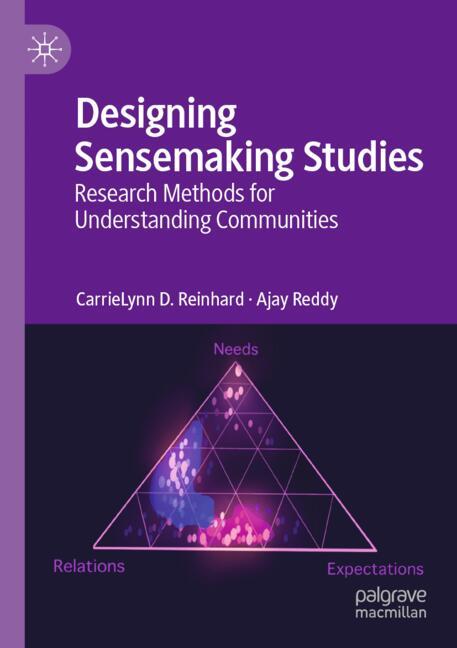
A guide from first question to action, for new and experienced researchers. Drawing on Active Sensemaking and Brenda Dervin's Sense-Making Methodology, it covers designing, running and using a study.
What's inside: An invitation to sensemaking · Why sensemaking matters · Approaches to sensemaking studies · Mixed-methods platforms · Discovering, designing, running, exploring, and using a sensemaking study · Future directions.
Why readers use this book
Ask for lived experience in a way people can answer honestly and safely.
Let participants, teams, and facilitators make meaning without collapsing nuance.
Use patterns to choose actions you can explain and revisit.
“The power of a sensemaking study goes beyond the data it produces.”
Keil Eggers · From the foreword, p. x
Included with the book through Studio
Ten modules follow the book’s ten chapters. The full self-paced course comes with the book through your Sensemaking Studio account.
Preview the first three modules →Watch the first three modules free. The full self-paced course comes with the book through Sensemaking Studio.
The intellectual trajectory that leads to sensemaking begins with systemic thinking. Early approaches emphasized the importance of seeing wholes rather than isolated parts, recognizing that human behavior and organizational life unfold within interconnected systems. From systemic thinking, scholars moved toward evaluation, seeking methods to measure and assess these systems in ways that could inform practice. Evaluation then gave rise to user‑centered design, which shifted attention from abstract systems to the lived experiences of individuals navigating them. Sensemaking emerges as the pragmatic culmination of this trajectory: a way of studying how people actually interpret, narrate, and act within complex realities. While grounded in humanist philosophy, sensemaking often feels unfamiliar compared to traditional approaches because it insists on honoring the messy, subjective, and narrative dimensions of human life rather than reducing them to neat metrics. Sensemaking studies require time to "do it right." Unlike quick evaluations or short‑term design projects, sensemaking unfolds across extended periods as individuals and groups reflect, narrate, and reinterpret their experiences. This long‑term perspective allows researchers to capture the evolving patterns by which people make sense of ambiguity and change. Whether studied at the level of the individual, the collective, or what we call natural sensemaking, the central activity remains pattern recognition: discerning how perceptions, stories, and actions cluster into meaningful structures that guide behavior. Different theorists and empiricists have developed various approaches (e.g. Human-Systems Dynamics, Active Sensemaking, Sense-Making Methodology, Weick’s organizational sensemaking). This handbook presents a general approach that draws on commonalities across these schools—emphasizing storytelling and collaborative analysis from Active Sensemaking and the focus on individual sensemaking within situations from Sense-Making Methodology. Sensemaking studies enable people and groups to uncover patterns in their experiences, identifying problems and solutions to empower action and change. They provide a foundation to build a bridge between qualitative and quantitative research, gathering in-depth, insightful information at scale and collaboratively analyzing it to generate useful strategies to improve people's lives. What does this book do? The book makes the argument for adopting sensemaking studies to understand humans, their actions, and their organizations, whether a small community or a large multinational corporation. The goal is to communicate links between theoretical understandings of sensemaking and methods of studying it with the practical needs of professionals to help them facilitate group discussions and research audiences, users, and other communities being served. The book establishes the ethical and methodological preconditions for sensemaking work. It names a simple but often ignored truth: meaningful data only emerges when people believe their experience will be treated with dignity and care. Our goal is to present the steps necessary to produce a sensemaking study, regardless of the specific theoretical or methodological approach taken. The handbook aims to make studying sensemaking simpler while retaining the complexity of what sensemaking is and how to study it—providing an "interface" to help people do sensemaking work, whether as academic research projects or consulting for organizations and communities.
Welcome to Designing Sense-Making Studies, a hands-on course inside Sense-Making Studio. This is Module 1, An Invitation to Sense-Making. If you've just opened Studio for the first time, you're in the right place. This video is about the one move everything else depends on. Before the instrument, the invitation. A sense-making study doesn't begin in software. It begins with a situation, something real, where the numbers look fine, but the reality doesn't feel fine. A service people quietly stop using. A team that agrees in meetings and stalls afterward. Hold one of those situations in mind as you watch. You'll write it down at the end. Here's the moment this course keeps returning to. A public appeals tribunal in British Columbia mailed out satisfaction surveys and got back one or two a year. They could have pushed harder, more reminders. more pressure. Instead, the chair, Emily Drowne, changed the question. She invited people to retell one specific moment, and then to say what it meant to them. Responses started arriving almost immediately, and one participant wrote something that still stops us. Wow. No one's ever wanted to know what I thought before. So before any tool, whose experience needs to be heard? Not users in general, the people whose days are actually shaped by your situation. and ask what it would take for them to really take part. Language, time, technology, risk? If a meaningful part of them can't participate, your patterns will describe access, not experience. This is why collecting responses is different from inviting stories. A response instrument controls answers. It decides in advance what can be said, and the analyst decides later what it meant. An invitation works the other way. It asks for a moment. Something that happened. and then lets the teller say what that moment meant. The interpretation stays with the person who lived it. That's not a courtesy. It's where the signal comes from. Concretely, an invitation sounds like this. Think of a specific time you dealt with our service. What happened? And then a few interpretive questions the teller answers about their own story. Event-based? Voluntary? No right answer. Notice what it doesn't ask for. A rating. Now, open SenseMaking Studio. Your account already contains a working study, a starter instrument, alongside practice material. You don't design anything in this module, and you don't publish anything. Think of Studio for now as a flight simulator. Everything is real except the passengers. Find the practice stories. They're clearly fictional, and that's the point. Open a few in the story table. For each one, read the story first, then look at how its teller interpreted it. That pairing, a story, plus its teller's own reading of it, is the unit of evidence this whole method is built on. One rule for this module, no live participants yet. When the tribunal's study went live, the chair said, I was terrified, because a real invitation changes a social contract. What's safe to say? Who is listening? What follows? Until you can honor what comes back, practice on fiction. Nothing you do in this module reaches a real person. Your first artifact is a learning contract. A short, honest page you write for yourself. Five lines. The situation I care about. Whose experience needs to be heard. What I hope to learn from this course. What I will not do yet and write this one out in full. I will not invite live participants until the course reaches live collection. And finally, how I'll know this course worked for me. Keep it under a page. You'll revise it as you go. That's expected, not failure. Your first artifact is a learning contract, a short, honest page you write for yourself, five lines, the situation I care about, whose experience needs to be heard, what I hope to learn from this course, what I will not do yet, and write this one out in full. I will not invite live participants until the course reaches live collection. And finally, how I'll know this course worked for me. Keep it under a page. You'll revise it as you go. That's expected, not failure. None of this makes a study valid or ethical by itself. Those are commitments you keep, not boxes you check. What this module gives you is the posture, begin with the situation, find whose experience matters, and turn extraction into invitation. When your contract is saved, you're done here. The rest of Module 1 continues in the app.
Transcript from the video’s caption track.Presents an argument for why sensemaking studies have real-world applications in marketing, customer service, and community development. Explains why sensemaking is not a "soft" alternative to analysis, but a necessary capability in environments where facts are shared and meanings diverge. Sensemaking studies help researchers uncover deeper insights by revealing hidden patterns and catalyzing evidence-based decision-making. Through organizational, public-sector, and AI-adjacent examples, the chapter shows how coordination failures arise from meaning gaps, not information gaps.
Module 2 of Designing Sense-Making Studies Why Sense-Making Matters In Module 1, we said a study begins with an invitation. This module answers the next question a busy leader asks, Why is this worth doing well? The short answer, because the hardest problems you face are not data problems. They're meaning problems. Organizations rarely suffer from too little data. They suffer from too little shared meaning. People can look at the very same facts and live in completely different interpretations of them. Work gets hard when those differences stay invisible. And the strategic advantage here is not certainty. It's faster learning that stays grounded in real experience. Here's what that looks like. One leadership team, one meeting, reviewing a new AI assistant. Everyone nods. The meeting ends on time. Then the retellings begin. The product lead story is progress. We're finally cutting manual work. The customer advocate's story is exposure. If this tool sounds confident but is wrong, we could harm the people we serve. The IT architect's story is integration. The model is the easy part. Identity and security are the real complexity. Same meeting. Three worlds. Nobody is lying. It is very rare that someone is lying. It is very rare that someone is simply resistant to change. They are standing inside different obligations, different risks, and different kinds of responsibility. So the leader's job is not to make everyone agree. It's to make those differences visible early, while change is still feasible. Now scale it. Ask three people to interpret their own experience, and you have three anecdotes you can argue about. Ask 30, with sliders and a triad they place themselves on, and you don't have anecdotes anymore. You have a pattern map. You can see where interpretations cluster. where they diverge, and where drift is starting, early enough to act before it becomes conflict or attrition. This is why meaning matters strategically. Meaning-based signals arrive before the dashboard moves. By the time a KPI shows a problem, the system has usually already adapted around it, often in costly, invisible ways. Confusion, workarounds, silence, a rise in small complaints, a sudden drop in initiative, those show up first, if you are set up to see them. It also takes the weight off the center. Leaders can fall into what White called the fallacy of centrality, assuming that if something mattered, they'd already know. When more people are allowed to make meaning, the organization learns faster and adapts with less rework. Across the interviews for the book, two uses came up again and again. In the first, an evaluator looks into a community to understand and serve it, an audience, a market, a neighborhood. In the second, a facilitator helps a community look into itself, usually at a moment when something isn't working and the group needs to learn. Same method, who's holding the mirror is what changes. One warning this chapter keeps returning to, the most actionable insight often hides inside apparent agreement. People say yes and mean different things. They use the same word and live in different experiences. Sense-making protects you from misdiagnosing resistance. When the real issue is competing obligations, it makes the difference visible, safely, instead of forcing it into an argument. So how is this different from the usual methods? The deepest difference is who owns the meaning. A traditional study asks for opinions which pull people toward abstraction. It averages answers which hides polarized reality. And it leaves interpretation to the analyst, which strips away context. A sense-making study asks for a lived moment, keeps the whole distribution, and lets the teller say what it meant. Interpretive authority sits with the participant. There's a mindset shift underneath all of this. Traditional logic wants clean boundaries, fixed categories, and neat themes. It treats a messy situation as a problem to be tidied. Pattern logic expects surprise, fuzzy boundaries, messy mixes, coherence that emerges rather than coherence you impose. In the sticky, non-repeatable situations leaders actually face, you don't ask what caused what. You ask what this plausibly contributed to, and what evidence would change your mind. So that's why it matters. Sense-making lets you see what's real instead of what's assumed. Surface difference safely instead of arguing about the slide deck, and learn faster than a lagging dashboard ever will, because facts don't coordinate action, meaning does. Next, in Module 3, the main approaches to sense making and what each one makes visible.
Transcript from the video’s caption track.Delves into the different approaches to sensemaking studies. The core principles of Active Sensemaking, Human Systems Dynamics, Sense-Making Methodology and more are introduced and compared to provide a holistic understanding of the different schools of sensemaking. These schools are further related to the traditional quantitative-qualitative divide and issues related to situating people in time-space to demonstrate how different sensemaking studies are complementary, bridging a methodological gap without sacrificing the benefits of either approach. Instead of arguing for one school, the chapter clarifies what each approach makes visible, who gets to interpret, and what kind of action it supports.
Module 3, Approaches to Sense-Making Sense-making comes in several schools, each with its own language and craft. This module puts the main ones side by side, but the goal is not to crown a winner. It's to help you choose or combine, based on your real design pressures, scale, sensitivity, time, and who needs to interpret. Start with a reframe. In sense-making work, your method is in a technical detail. It's a contract about meaning. It sets what counts as evidence, who gets to interpret it, and what kind of action it's meant to enable, a decision, a dialogue, an experiment, or accountability. So the question is never simply which tool. It's which approach keeps meaning intact at the scale you need. Here's why that matters. In a global study of humanitarian response, the Women's Refugee Commission found one word doing a lot of quiet damage, local. On the project plan, it looked like a clean checkbox. In the field, local behaved like weather. Contextual, shifting, sometimes contested. When a word carries different obligations depending on where you stand, measuring it without meaning doesn't clarify. It obscures. So before you choose a method, answer five meaning contract questions with your sponsors. What must become visible? A pattern you can't currently see. Who needs to interpret it? And who must not be harmed by that visibility? What nuance is non-negotiable? What would be lost if we averaged it? How fast do the learning loops need to be? And what will we actually do differently if we learn it? Answer those, and you can usually draft a minimum instrument in under an hour. Now the schools themselves. Three of them center the storyteller's own interpretation. Participatory narrative inquiry, Cynthia Kurtz's approach, has groups work with raw stories of lived experience and make sense of them together. Active sense making is the simplest repeatable loop. Invite a moment, let the author interpret it, look at patterns, and sense-making methodology. Brenda Durven's follows how a person bridges a gap and moves forward. Three more strengthen different parts of the work. Human systems dynamics, Glenda O. Young's helps people see and shift the patterns a system keeps producing. Phenomenological ethnography stays close to lived experience, capturing individual stories alongside measures. and group facilitation practices, liberating structures, agenda shift, make dialogue itself the method so a room can surface difference without it turning into a fight. Underneath the choice is a question of situation. The Kineven framework from Dave Snowden warns against treating a complex situation like a merely complicated one. In the complicated world, expertise and analysis find the right answer. In the complex world, cause and effect only make sense in hindsight. So you probe, sense the patterns, and respond, rather than planning your way to certainty, or all their differences. The schools share one loop, and this handbook uses it as the through-line because it's the simplest thing that scales. Invite a concrete moment. Let the author interpret it. Look at the patterns across many. Interpret them together. Take one safe-to-try step. Then revisit what changed. Every approach strengthens some part of that rhythm. None of them replaces it. And notice what the real difference is not. It's tempting to file all of this under qualitative versus quantitative, numbers versus narratives. That's the wrong axis. The difference that matters is where interpretation lives, how tightly meaning stays tethered to context, and how quickly an insight can turn into responsible action. Plenty of strong studies use numbers and narratives at once, which is why most strong studies are hybrids. The craft of sequencing approaches without losing the nuance you're trying to learn from and matching the instrument to the people. A triangle signifier can be powerful, but it's optional, not a default. When inclusion or felt safety is the constraint, a simpler dyad or scale often serves people better. Respect the situation and the method follows. So when you sit down to choose, don't ask which method is best. Ask what must become visible. who needs to interpret it safely, and how fast you need to learn. Let those answers pick the approach or the blend of approaches. The school is just the craft. Keeping meaning intact is the point. That's the map of approaches. Choose for meaning, for scale, for the safety you owe people, and for the learning loop the situation needs. Next, in Module 4, the platforms that carry these methods and how the platform itself shapes what people can safely say.
Transcript from the video’s caption track.Argues for a mixed methods approach to sensemaking studies and presents different online tools that can be used to conduct a sensemaking study. The chapter addresses the reality that platforms shape method: in sensemaking work, the platform is not neutral—it affects who participates, what can be said, how meaning travels, and how trust is maintained or broken. The chapter reframes platforms as meaning containers and offers platform-agnostic criteria for protecting nuance, ethics, and learning loops. Such platforms afford automation and scalability for qualitative data collection and analysis that also supports quantitative data collection and analysis, and allow researchers to balance macro- and micro-levels of analysis.
This module is available through Sensemaking Studio with your book.
Presents the first step in conducting a sensemaking study by discussing how to discover the questions underlying the study. It clarifies what must become visible before designing prompts or dashboards and treats discovery as the first act of sensemaking, not a preliminary administrative step. Initial steps include exploring cultural factors, getting stakeholders involved, and determining the "sticky situation" or problem at hand. Using real cases, it shows how vague concerns become actionable visibility goals and how researchers can collaborate with their community to develop the study's research questions so the study benefits the most people.
This module is available through Sensemaking Studio with your book.
Builds on the previous "getting started" chapter by presenting strategies to convert research ideas and questions into measurements that ensure the sensemaking study's usefulness. The chapter is about craft: it shows how to translate discovery into prompts, signifiers, sampling strategies, and protections that preserve meaning rather than forcing compliance. Design is treated as iterative sensemaking, not questionnaire assembly. It covers the design process from principles for writing prompts that evoke lived moments to harm-reduction and protection practices built into design.
This module is available through Sensemaking Studio with your book.
Presents techniques for data collection strategies to maximize research goals and community engagement. The chapter focuses on hosting: running a study is not deployment but ongoing facilitation of safety, clarity, and trust under changing conditions. It emphasizes inclusion, run-health monitoring, and ethical boundaries during live collection. The discussion includes challenges for scaling and recruiting narratives and ethical considerations for ensuring rich data is gathered that represents the community being studied.
This module is available through Sensemaking Studio with your book.
Presents different analytical approaches: coding and thematic clustering for qualitative data, and statistical analysis for quantitative metrics. It discusses how to visualize patterns and associations at scale while conducting community sensemaking and iterative data analysis that allows researchers to engage with the studied community to collaboratively produce insights. The chapter is about interpretation—working with distributions, edges, and clusters without collapsing nuance or rushing to certainty. Through institutional and intimate cases, it demonstrates how patterns become mechanisms and how mechanisms point toward changeable conditions.
This module is available through Sensemaking Studio with your book.
Presents the final step by exploring how to visualize, publish, and act upon the findings. For example, Spryng.IO dashboards can be leveraged to visualize patterns and associations at scale and published as interactive presentations to allow further community exploration. The chapter addresses the hardest part: action without betrayal. It focuses on publishing, governance, and turning insight into safe-to-try experiments tied to meaning mechanisms. It discusses "next wise actions" such as designing experiments, identifying solutions, innovations, ownership of actions, conditions for amplification/dampening, and tracking signs of success/failure. Use is treated as a continuation of sensemaking, not a handoff.
This module is available through Sensemaking Studio with your book.
Presents a recap of sensemaking fundamentals as well as resources for advanced learning. Suggestions are made on how to adapt sensemaking approaches for evolving organizational and community needs. The chapter concludes with a look forward: how sensemaking practices evolve in an AI-accelerated, governance-constrained world, without losing human agency or ethical grounding. The focus is anticipatory learning, not prediction.
This module is available through Sensemaking Studio with your book.
The book moves from invitation → justification → choice → infrastructure → discovery → design → hosting → interpretation → action → future capability.
CarrieLynn D. Reinhard is Assistant Professor of Applied Communication at Dickinson State University and studied with Brenda Dervin at Ohio State University.

Ajay Reddy is the founder of Spryng and works in Active Sensemaking research and AI/ML product development.
See what’s included
Your book includes a free year of Studio: one facilitator, up to 10 participants and 50 stories a month. Proof of purchase gives you 365 days; library readers can request 90 days.
Claim your free yearFrom your first question to exploring stories and choosing what to try next. A short Studio overview. 1:14
A survey can tell you what people selected, but what happened? What did it mean to them? And what might you be missing? Sense-Making Studio brings lived experience into view. People share a story, then interpret it themselves, showing what mattered and how they understood the experience. Across those stories, patterns begin to emerge, places where experiences gather, differences worth exploring, surprises that invite a better question. Every pattern is a place to begin. Return to the stories, compare perspectives, ask what conditions might explain the difference, and look for experiences that challenge your first interpretation. Start with a ready-made questionnaire, adapt it to your context, and invite people to contribute. Bring colleagues into the exploration while keeping participants' own interpretations close. New to the practice? The 10-module course, Designing Sense-Making Studies, guides you from your first question through designing, running, and exploring a study and putting what you learned to use. Use what you learned to choose a small change worth trying. Then return, listen, and learn again. Sense-Making Studio, make room for experience. Find your next question.
Transcript from the video’s caption track.Studio for readers includes 1 facilitator, up to 10 participants, 50 stories a month, and 1 instrument and 1 collection. That is enough to design a prompt, collect a first round of stories, and let participants interpret their own stories.
When that first study is done, an Event Pass is the next step for a live workshop. It is priced on the Event Pass card. After Studio lapses, you have a 30-day read-only export window.
What readers actually practice
Studio includes one instrument. Pick the one that fits the work, then open its guide when you are ready for details.
Studio is a supported practice environment. Limits and terms may evolve over time; updates are communicated clearly in advance.
When the work grows
The path is the book, then a free year of Studio, then an Event Pass when you run a live workshop. Further plans exist when the work needs more than one event:
Yes. Use one Studio instrument as a bounded practice loop. If you need many participants, multi-room collaboration, or ongoing client engagements, move to Praxis or our Conference & Workshop Event Pass ($299 one-time).
Use Studio for a light demonstration or reflective exercise. For live summit collection, QR onboarding decks, and real-time Decision Rooms, use our Conference Event Pass ($299 one-time) or Praxis.
Start in Studio to practice the fundamentals. When your organization needs multi-team access, custom governance, or leading studies for others, move to Praxis or explore a partner collaboration.
“Sensemaking is the disciplined work of observing reality, interpreting it honestly, and responding wisely.”
From the preface, p. xiii
Palgrave Macmillan (Springer Nature), 2026. Print (softcover) ISBN 978-3-032-25165-7. eBook ISBN 978-3-032-25166-4.
Book excerpts © 2026, reproduced from Designing Sensemaking Studies. Cover illustration: Diya Grace Reddy. Published by Palgrave Macmillan.