Epistemological Validity, Self-Signification, and Human Subjects Ethics in Active Sensemaking
A Methodological Treatise on Compositional Simplex Geometry, Critical Realist Sensemaking Ontology, and Dynamic Human Subjects Safeguards for Complex Systems Inquiry

Designing Sensemaking Studies: Research Methods for Understanding Communities
“I have spent the better part of three decades arguing that human matters cannot be adequately understood through the mechanisms we use to measure machines... Reddy and Reinhard have done something rather useful and slightly unfashionable: they have taken the philosophical commitment to human interiority and given it operational form... What this book proposes instead is patient, disciplined attention to lived experience, and the humility to let people interpret their own moments, rather than surrendering that authority to an external analyst or an algorithm.”
“In an outcome-based culture, it is more natural to ask, “What do you want to happen?” rather than “What happened to you?”... Researching a complex system is an intervention in itself. When you ask people to share stories of lived experiences and self-signify the forces acting upon them, you shift from deficit-based categorization to emergence. Sensemaking becomes a continuous capacity to interact with a complex world.”
The Epistemological Crisis in Human Systems Inquiry
Why classical Likert surveys, extractive qualitative interviews, and unanchored AI summaries fail in complex social environments.
1.1 The Failure of Classical Likert Scaling
Contemporary organizational and social inquiry suffers from a profound methodological failure: the presumption that human experience can be accurately captured through single-item or multi-item ordinal Likert scales. Decades of cognitive survey research (Tourangeau et al., 2000; Krosnick, 1991, 1999) demonstrate that Likert instruments disrupt natural cognition across four stages:
- Comprehension Distortion: Respondents misinterpret abstract institutional prompts ("I feel psychologically safe in my division") according to local idiosyncratic frames.
- Retrieval Failure: Rather than retrieving episodic memories of lived events (Tulving, 1983), respondents perform cognitive satisficing (Krosnick, 1991), substituting generalized semantic platitudes.
- Estimation Compression: Complex, multidimensional lived tensions are artificially compressed onto arbitrary 1-to-5 ordinal scales.
- Reporting / Social Desirability Bias: Employees and community members intuit the socially or organizationally rewarded answer, straight-lining or choosing the safe midpoint.
Furthermore, as demonstrated by Podsakoff et al. (2003), self-report surveys measuring both predictor and criterion variables in identical formats suffer massive Common Method Variance (CMV), which can inflate spurious statistical correlations.
1.2 The Extraction Problem & Algorithmic Reduction
To circumvent survey flaws, organizations frequently turn to qualitative interviews or focus groups. However, traditional qualitative methods introduce Analyst Epistemic Imposition:
- Observer Imposition: External researchers apply subjective thematic codebooks in qualitative analysis software, filtering participant voices through academic jargon and executive expectations.
- Cherry-Picking: Decision-makers select evocative quotes that affirm pre-existing strategic decisions while discarding contradictory lived edge cases.
- Algorithmic Homogenization: Modern "AI sentiment analysis" and LLM thematic summaries treat language as ungrounded "stochastic parrots" (Bender et al., 2021). LLMs hallucinate thematic consensus and smooth out critical dissenting voices to satisfy probabilistic token distributions (Crawford, 2021; Zuboff, 2019).
“What Reddy and Reinhard propose instead is patient, disciplined attention to lived experience, and the humility to let people interpret their own moments, rather than surrendering that authority to an external analyst or an algorithm.”
1.3 The Active Sensemaking Paradigm
Active Sensemaking resolves this crisis by establishing Participant-as-Theorist Sovereignty (Dervin, 1992, 2003). Participants first share an unprompted retrospective micro-story of a specific lived moment (anchoring episodic memory). Immediately thereafter, the participant self-signifies that narrative by positioning it onto continuous geometric coordinate spaces (barycentric triads and bipolar dyads).
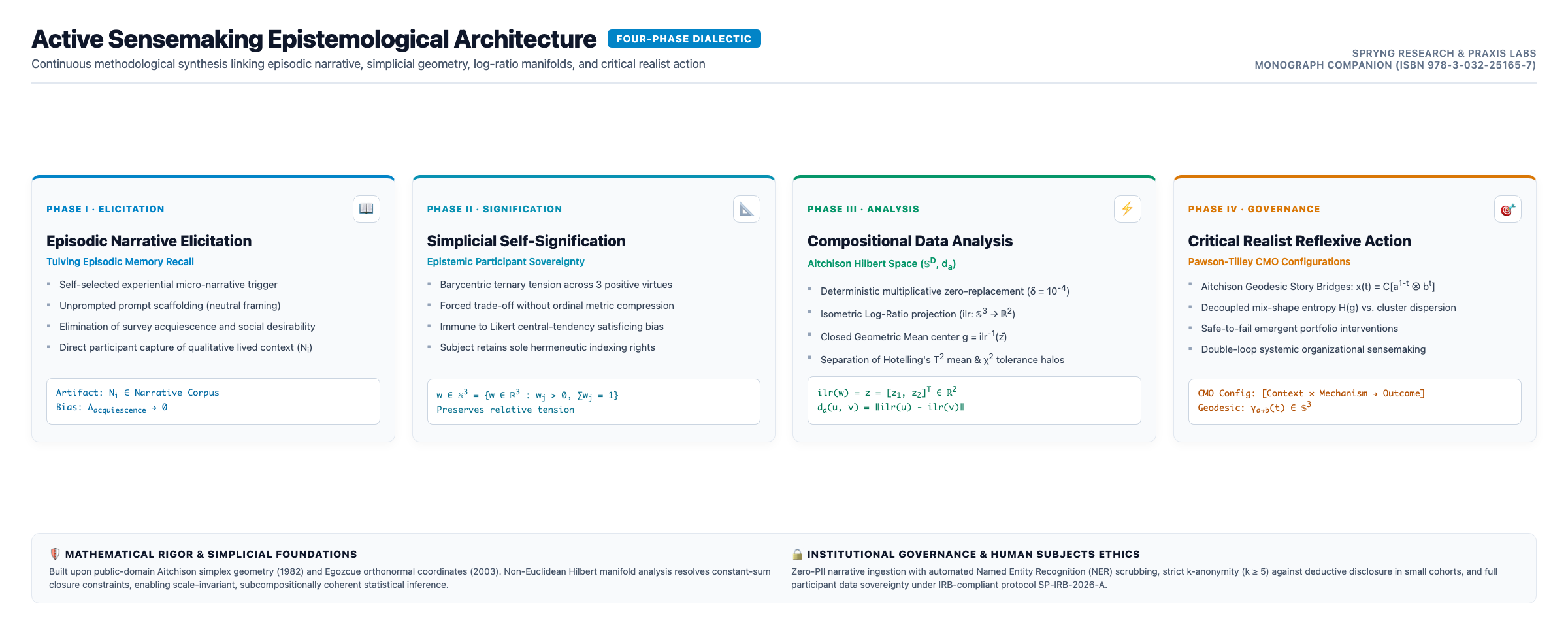
Figure 1. Active Sensemaking Epistemological Architecture: Four-Phase Dialectic linking episodic narrative elicitation, simplicial self-signification, CoDa log-ratio Hilbert manifolds, and critical realist action (Reinhard & Reddy, 2026, Fig. 3.1).